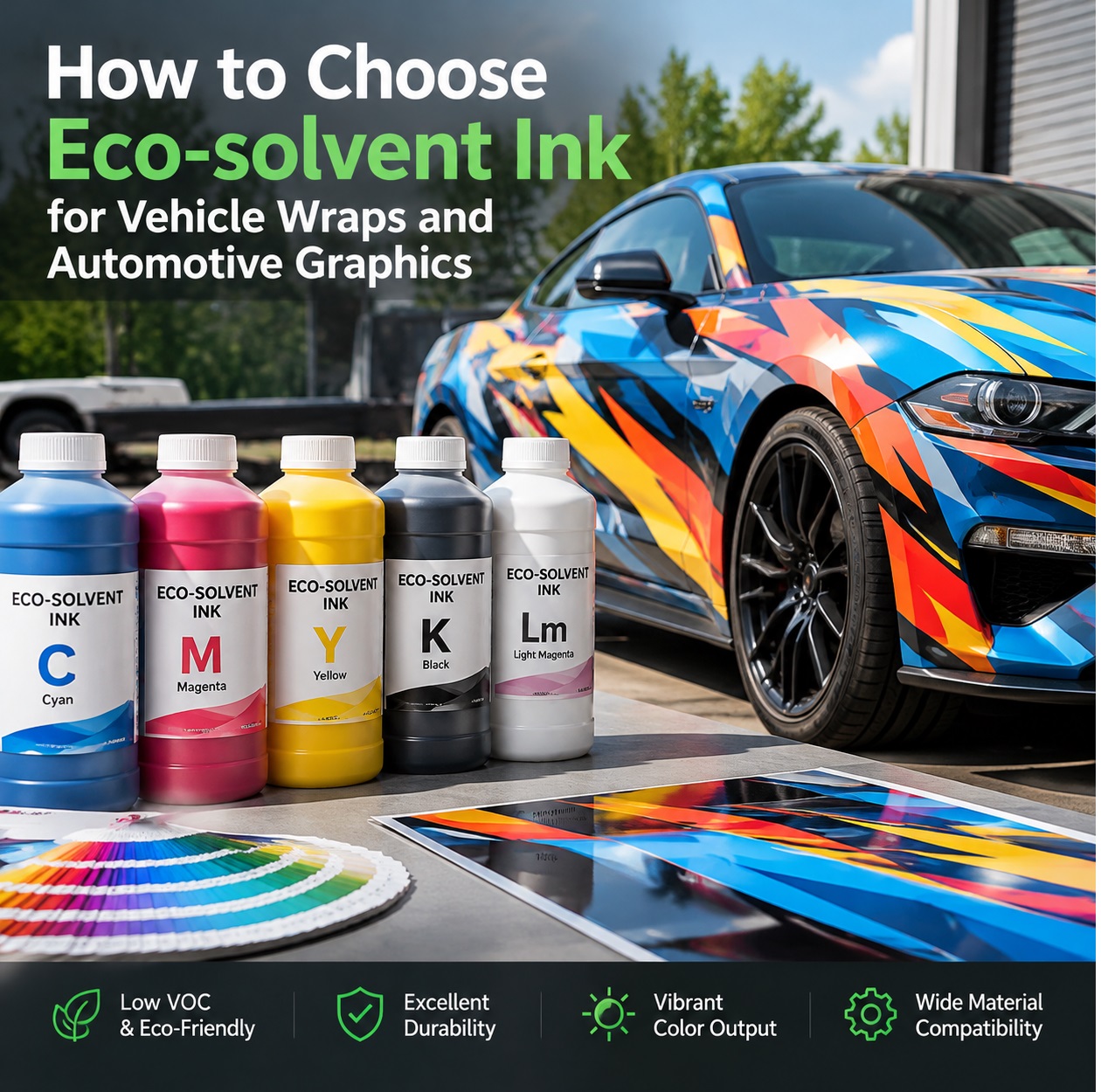
 A vehicle wrap that fades in eighteen months isn’t a wrap. It’s a rolling apology. That’s the uncomfortable truth behind every eco-solvent ink decision, and it’s why the cheapest cartridge on the shelf is almost never the bargain it looks like.
Eco-solvent ink sits in a useful middle ground. It’s milder than aggressive solvent inks, easier on ventilation, and still capable of printing onto the flexible vinyl that vehicle wraps and automotive graphics demand. But “eco” does not mean “universal.” A formula that looks brilliant on a banner can turn brittle over a wheel arch, bleed under a clear laminate, or shift color when a fleet manager compares two vans side by side.
Start with the machine, not the price tag. Every eco-solvent printer has its own printhead, heater settings, and maintenance rhythm. OEM ink usually protects your warranty and comes with validated profiles, but reputable third-party inks can perform beautifully when the manufacturer supplies accurate ICC profiles, consistent batches, and real technical support. The question is not OEM versus third-party. The question is whether the ink has been proven on your printer, with your media, in your shop’s humidity and temperature.
Then look at the vinyl. Vehicle wraps typically use cast PVC with pressure-sensitive adhesive, and automotive graphics may go on cast, calendared, or specialty films. Eco-solvent ink has to grab that surface without crawling, pool in the wrong places, or crack when a installer stretches it around a mirror or bumper. A print that looks perfect on the roll can fail the moment a heat gun hits it. So test the actual combination: ink, media, laminate, and application method. Print a panel, stretch it, heat it, cool it, and inspect for cracking, color shift, and adhesion loss.
Color consistency is where marketing promises meet reality. Fleet graphics live and die by brand color. If a client’s red looks orange on one van and burgundy on the next, the wrap becomes a liability. Ask for ICC profiles, linearization support, and batch-to-batch consistency data. If you print the same logo across twenty vehicles, lot numbers matter. So does metamerism, because a color that matches under shop lights may fall apart under daylight. A good ink supplier should help you build a repeatable color workflow, not just sell you liters.
Durability is not one number. It’s a stack of variables: UV resistance, abrasion resistance, chemical resistance, and laminate compatibility. Eco-solvent prints on vehicle wraps are usually laminated, and that laminate can hide a lot of sins until it doesn’t. If the ink is not fully cured, trapped solvent can cause bubbles, silvering, or delamination weeks later. Curing depends on ink chemistry, printer heaters, media coating, print speed, and ambient humidity. Do not trust a preset just because it came from the RIP. Run a rub test, a tape test, and a careful visual check before you laminate a full roll.
Environmental claims deserve scrutiny too. Eco-solvent inks generally produce lower VOCs and less odor than full-solvent inks, but they are still solvent-based. If your shop serves schools, hospitals, or retail interiors, look for certifications such as Greenguard Gold or comparable indoor air quality approvals. If you market to eco-conscious clients, be precise. “Lower VOC” is honest. “Green” without proof is just a word. Worker safety still matters: ventilation, gloves, storage, and waste disposal are part of the ink choice, not an afterthought.
The real cost calculation is not price per milliliter. It is cost per square foot of finished, sellable wrap. Add wasted media, clogged printheads, reprints, lamination failures, labor, and the reputational damage of a job that comes back. Cheap ink that saves pennies but ruins a five-thousand-dollar fleet wrap is expensive. A premium ink that runs clean, matches brand colors, and survives three winters is cheap by comparison.
Supply chain and support round out the decision. Can you get cartridges next month? Does the manufacturer offer warranty support if something goes wrong? Are there chips, firmware locks, or regional restrictions that could leave you stranded? Does the ink have a shelf life that fits your production volume? A great formula with terrible availability is a trap.
For vehicle wraps and automotive graphics, choose eco-solvent ink the way you would choose a laminate or a vinyl: by proven performance, not by packaging. Demand sample prints on cast vinyl. Ask for weathering data, adhesion tests, and color profiles. Confirm the warranty path. Then run your own test before you commit a fleet.
Your customer does not care which cartridge you loaded. They care that their logo still looks sharp after a hundred car washes, a summer of UV, and a winter of road salt. Choose ink that keeps that promise. Everything else is just ink in a box.