 A coverall that sheds one extra particle per minute can cost a fab more than the entire garment budget. That is the uncomfortable math behind cleanroom protective coveralls in semiconductor manufacturing. They are not uniforms. They are contamination-control equipment, ESD safeguards, and yield insurance. If you are buying them based on price per box or how soft the fabric feels, you are already losing.
Start with the cleanroom class. A garment approved for ISO Class 7 is not automatically acceptable in an ISO Class 4 or 5 area. Semiconductor fabs usually demand low particle shedding, low outgassing, and consistent performance. Ask for particle-count data from a Helmke drum test or equivalent. Look for results at the size ranges that matter to your process. A supplier who says “cleanroom compatible” without test reports is asking you to trust a brochure. Do not.
Then look at ESD. Semiconductors are sensitive to static discharge. A coverall must be part of a grounded ESD program. That means conductive or dissipative fibers, typically carbon core or carbon-printed fabrics. Check surface resistivity, static decay time, and whether the garment maintains performance after repeated laundering. A coverall that works on day one and fails on wash twenty is a defect generator. It must also integrate with hoods, boots, gloves, and wrist straps. If the system is not continuous, the human body becomes an ungrounded conductor.
Material choice comes next. Reusable coveralls made from polyester with conductive fibers are common in fabs because they offer consistent cleanliness and lower cost per use. Disposable garments can be useful in some non-critical areas, but they often shed fibers, generate waste, and vary in ESD performance. The decision should be driven by your gowning protocol, cleanroom class, and contamination-control plan. Not by a generic “disposable is cleaner” assumption. In many semiconductor environments, a validated reusable garment laundered in a cleanroom laundry is the stronger choice.
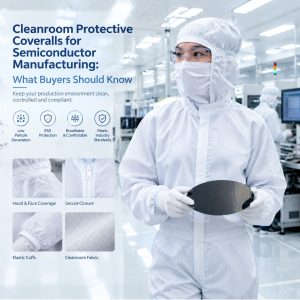
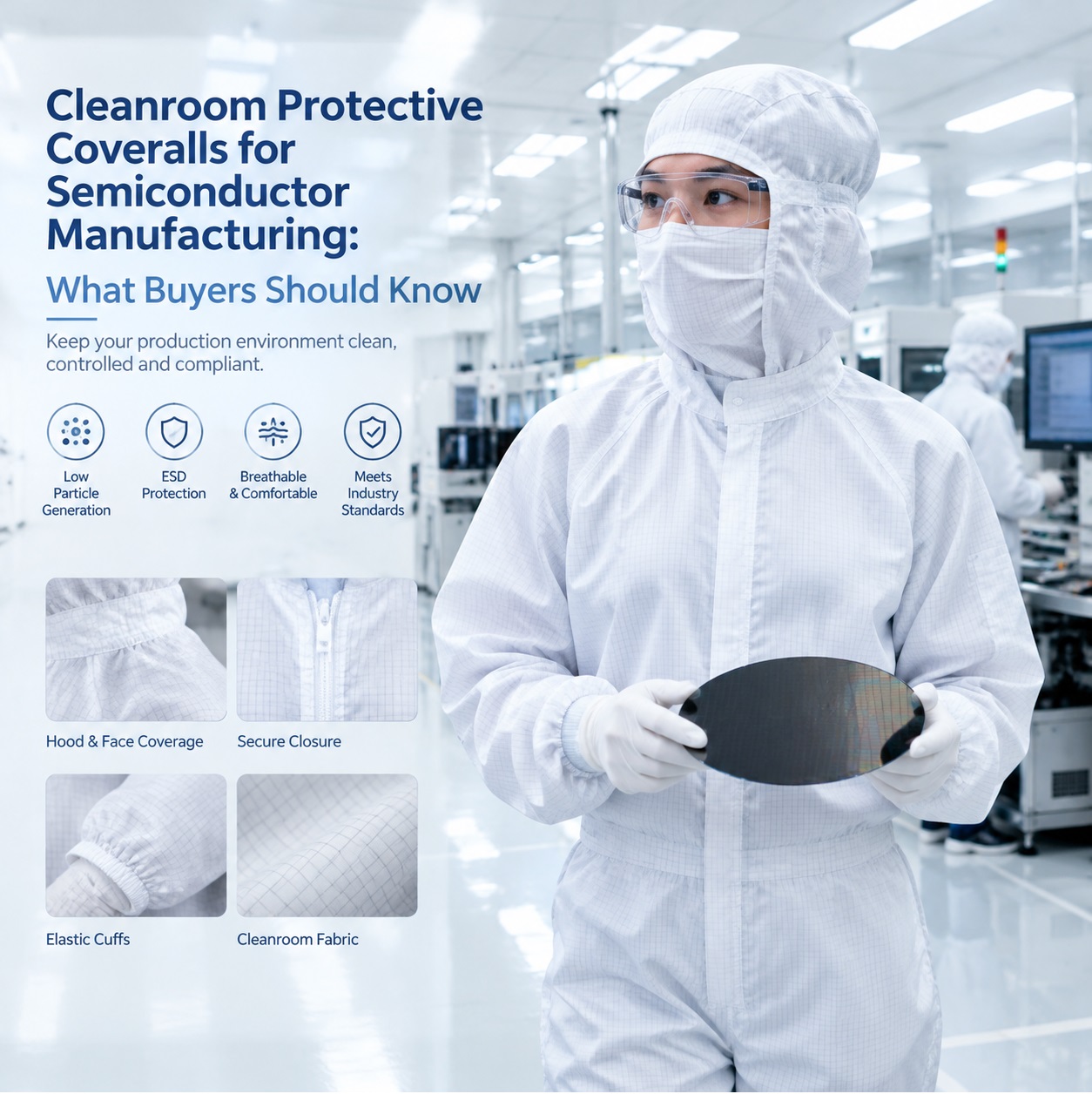
Design details matter more than buyers expect. Every seam is a potential particle source. Bound or welded seams reduce shedding. Zippers need a storm flap. Cuffs need to seal against gloves. Thumb loops keep sleeves in place. The hood and face opening must fit without gaps. Velcro, exposed snaps, and loose threads are contamination traps. Fit is also a performance issue. Too loose, and the garment bellows particles with every movement. Too tight, and it tears, binds, and discourages proper wear. Comfort is not a luxury. It is a compliance tool. If operators hate the coverall, they will adjust it, remove it, or wear it wrong.
Laundering is where many programs quietly fail. Reusable coveralls must be processed in a cleanroom laundry with controlled water, detergents, and drying. The laundry should inspect, repair, and retire garments on a documented schedule. Ask how garments are tracked. Can the supplier trace a coverall to its wash history? Can they prove that contaminated garments never mix with clean ones? Packaging matters too. Cleanroom-compatible bags, double bagging, and lot control protect the garment from the moment it leaves the laundry until it enters your gowning room.
Certifications help, but they are not a finish line. ISO 14644, IEST-RP-CC003, EN 1149, ANSI/ESD S20.20, and ISO 9001 are useful benchmarks. They tell you the supplier knows the language. They do not tell you whether the garment will perform in your fab. Ask for test reports specific to your cleanroom class and ESD requirements. Audit the laundry. Check the change control process. If the supplier switches fabric, thread, or carbon content without telling you, your validation is broken.
Total cost is another trap. A cheap coverall can be the most expensive purchase in the room. Calculate cost per use, not cost per unit. Include laundering, replacement, inspection, packaging, and administrative time. Then add the risk of yield loss. One particle or one ESD event can destroy more value than a year of garment spending. Buyers who understand this stop negotiating on pennies and start negotiating on data.
The best suppliers do not just sell coveralls. They ask questions. What is your cleanroom class? What is your ESD sensitivity? How do operators gown? What are your audit requirements? What does your contamination-control plan say about garment change frequency? They provide samples for validation. They support training. They keep supply consistent. They treat a coverall as part of your process, not a commodity.
When you evaluate cleanroom protective coveralls for semiconductor manufacturing, demand evidence. Particle counts. ESD decay times. Laundry validation. Traceability. Fit trials. If a supplier cannot provide those, keep looking. The right coverall will not just protect your product. It will protect your yield, your audit score, and your reputation. If you want a coverall program that holds up to fab audits and daily wear, choose a partner who can show the data before you sign the PO.